
FDA Statistical Software Requirements: The Regulatory Truth Behind SAS vs. R
Understand the FDA's official stance on statistical software, 21 CFR Part 11 validation, and why SAS continues to dominate clinical trial submissions.
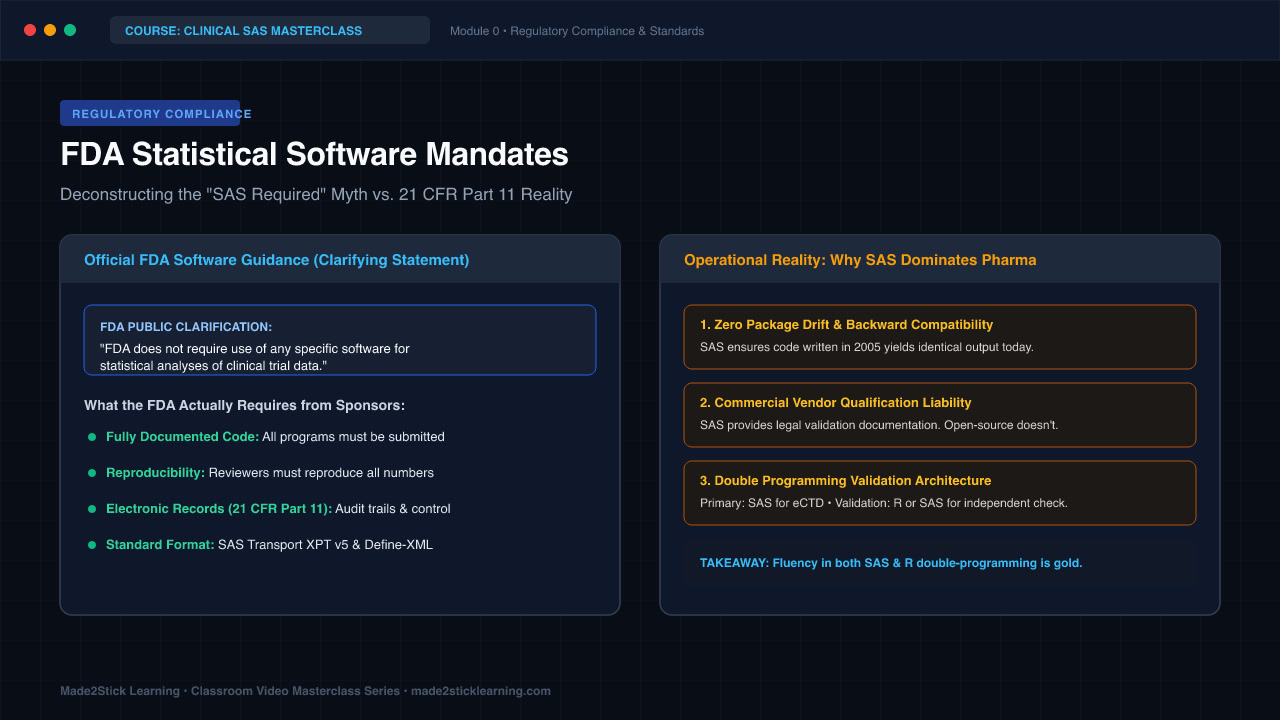
The FDA does not require, mandate, or endorse any specific statistical software package for clinical trial data analysis. Under the official FDA Statistical Software Clarifying Statement, sponsors may use any statistical programming environment (including SAS, R, or Python) provided the software is properly qualified, all algorithms and code are fully documented and reproducible, and the system complies with 21 CFR Part 11 requirements for electronic records.
Why Software Neutrality & Validation Governance Matter in Clinical Submissions #
While R is legally acceptable for regulatory submissions, more than 90% of New Drug Applications (NDAs) and Biologics License Applications (BLAs) are still submitted using SAS. This commercial reality stems from three factors: SAS backward compatibility across decades without package drift, vendor qualification liability from SAS Institute, and established agency review macros. Leading biostatistics organizations solve this debate through double programming—running primary derivations in SAS and independent duplicate validation in R.
Standard Syntax, Derivation & Framework Pattern #
/* 1. Primary Analysis Dataset Derivation in SAS */
DATA work.adsl;
    SET sdtm.dm;
    LENGTH SAFFL $1;
    /* Safety Population: Enrolled, randomized, and received study drug */
    IF ACTARMCD IN ('TRTA', 'TRTB') AND NOT MISSING(RFSTDTC) THEN SAFFL = 'Y';
    ELSE SAFFL = 'N';
RUN;

/* 2. Independent Secondary Validation in R (pharmaverse / admiral):
   library(admiral)
   library(dplyr)
   adsl_r <- dm %>%
     mutate(SAFFL = if_else(ACTARMCD %in% c("TRTA", "TRTB") & !is.na(RFSTDTC), "Y", "N"))

   # Automated Bit-Level Discrepancy Check:
   diffdf::diffdf(adsl_sas, adsl_r)
*/
Core Rules #
- The FDA Statistical Software Clarifying Statement explicitly confirms that the agency does not require any specific software package for clinical trial analysis.
- Regulatory compliance is determined by 21 CFR Part 11: full traceability, documented algorithms, environment qualification, and independent auditability—not vendor branding.
- SAS maintains 90%+ market dominance in NDA/BLA submissions because scripts written 15 years ago execute without code breaking, eliminating the severe package drift common in open-source ecosystems.
- The industry standard workflow is Double Programming (independent validation), where primary datasets and tables are programmed in SAS and verified independently in R or vice versa.
- Both SAS and R output files must be converted into standard SAS Transport (XPT v5) format accompanied by Define-XML 2.0 and the Analysis Data Reviewer's Guide (ADRG).
The regulatory truth behind the FDA clarifying statement, package drift, 21 CFR Part 11 liability, and double-programming workflows.
Frequently Asked Questions (FAQ) #
Does the FDA reject regulatory submissions programmed entirely in R?
No. The FDA has repeatedly confirmed and accepted submissions containing analysis datasets and statistical models generated in R. However, sponsors must provide complete code, reproducible environments (such as containerized package snapshots), and standard XPT/Define-XML submission files.
Why do pharmaceutical sponsors still pay millions for SAS licenses instead of switching entirely to free R?
Open-source software eliminates upfront licensing fees but shifts the full legal and operational burden of software qualification, test verification, and backward compatibility to the sponsor. When an FDA approval involves billions of dollars, pharmaceutical executives prefer the vendor-backed qualification liability and 40-year stability of SAS over maintaining custom internal package validation pipelines.
What is double programming in clinical trials?
Double programming is the regulatory quality control standard where two programmers independently develop the same dataset or summary table from the Statistical Analysis Plan (SAP) using separate code. The two resulting outputs are compared programmatically (such as via PROC COMPARE in SAS or diffdf in R) to ensure zero discrepancies before database lock.
Where can I read the in-depth technical breakdown and architecture of this debate?
Read our detailed companion article: Does the FDA Actually Require SAS? The Truth Behind the R vs. SAS Debate in Pharma, detailing 21 CFR Part 11 liability, package drift risks, and modern dual-stack pipelines.
Want complete video breakdowns, code files & exercises?
Explore comprehensive step-by-step masterclass training in our authoritative Clinical SAS Programming Course & CDISC Training.