

Executive Summary: Legal Neutrality vs. Production Reality
The FDA does not require SAS. Under the official FDA Statistical Software Clarifying Statement, sponsors may use any programming language—including R or Python—provided code is reproducible, documented, and compliant with 21 CFR Part 11. Yet SAS continues to run over 90% of regulatory New Drug Applications (NDAs). This persistence is not institutional inertia; it is driven by zero package drift across 15-year audit horizons, commercial vendor qualification liability, and established agency review macros. Leading pharmaceutical teams avoid language dogmatism by implementing Double Programming: writing primary derivations in SAS and independent validation scripts in R.
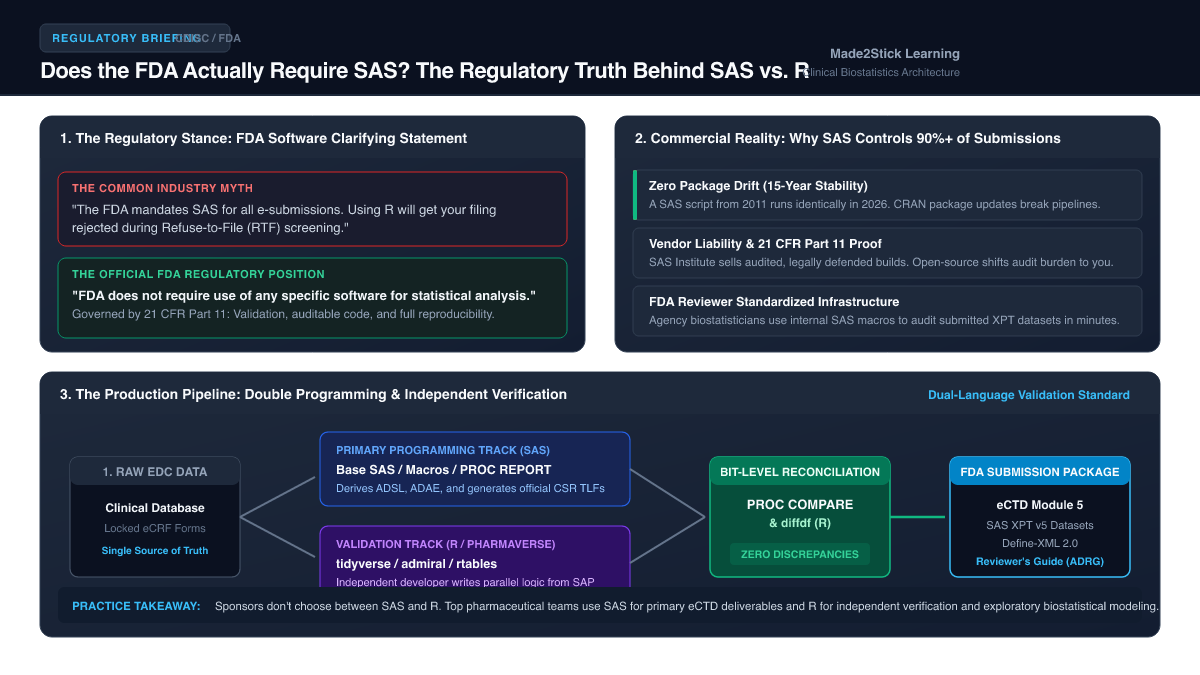
Figure 1: Regulatory Compliance Architecture — Official FDA Software Guidance, Enterprise Stability Mechanics, and Dual-Language Validation Pipelines.
The Persistent Myth: "The FDA Only Accepts SAS" #
Few misconceptions are as deeply entrenched across pharmaceutical LinkedIn and biostatistics forums as the belief that the United States Food and Drug Administration mandates SAS for drug submissions.
Junior programmers are routinely told that submitting an analysis programmed in R will result in an immediate Refuse-to-File (RTF) letter. The regulatory reality is quite different. The FDA issued an explicit public document addressing this exact point: the Statistical Software Clarifying Statement.
"FDA does not require use of any specific software for statistical analyses of clinical trial data. However, the software package(s) used for statistical analyses should be fully documented in the submission, including version and system environment."
— US Food and Drug Administration (FDA) Clarifying StatementAs a United States government regulatory agency, the FDA is prohibited by federal acquisition guidelines and anti-monopoly statutes from endorsing a private software vendor. You are entirely permitted by law to submit an NDA with analyses written in R, Python, Julia, or C++.
Why, then, do global pharmaceutical companies continue to spend tens of millions of dollars each year renewing enterprise SAS licenses when R is free?
The 21 CFR Part 11 Reality: The Sponsor Carries the Burden #
To understand why SAS maintains an iron grip on clinical development, you must examine how regulators enforce 21 CFR Part 11 and software qualification rules.
When an agency reviews a submission, they evaluate three primary technical criteria:
- Auditability: Can every derived data point be traced back to its raw electronic Case Report Form (eCRF) origin without ambiguous manual steps?
- Environment Qualification: Can the sponsor prove through formal documentation (Installation Qualification and Operational Qualification) that the execution engine calculates results correctly on that specific operating system?
- Deterministic Reproducibility: If an agency biostatistician executes your code ten years from now, will it produce the exact same numbers down to the fourth decimal place?
The catch with open-source software is accountability. Because R is released under open-source licensing with zero commercial warranty, the entire legal burden of software qualification, algorithm testing, and version verification falls on the pharmaceutical sponsor.
Three Technical Reasons SAS Dominates Production Submissions #
1. Package Drift and the Ten-Year Reproducibility Horizon #
In rapid web development or machine learning research, software updates every few months are standard practice. In drug development, clinical trials span five to ten years from protocol design to post-marketing commitments.
The R ecosystem relies on thousands of decentralized packages hosted on CRAN. When a package author updates an algorithm, introduces a breaking API change, or deprecates a parameter, downstream pipelines break. A script written in R 3.6 using an unpinned package from 2019 will rarely execute cleanly in R 4.4 without substantial dependency engineering.
SAS approaches backward compatibility with absolute rigor. A Base SAS DATA step written in SAS 9.1 twenty years ago will run without modification in SAS 9.4 Maintenance Release 8 today, yielding identical results. For regulatory submissions involving billions of dollars in drug development investment, predictable execution is mandatory.
2. Commercial Vendor Qualification Liability #
When an enterprise licenses SAS, it receives formal validation test suites, verified mathematical libraries, and legal qualification documentation directly from SAS Institute. If a statistical calculation is audited during an FDA inspection, the sponsor references verified vendor qualification test suites.
While consortiums like the R Submissions Working Group and the R Foundation have made tremendous strides in validating open-source packages (such as the pharmaverse initiative), qualifying an internal R distribution across corporate compute clusters requires dedicated internal validation engineering teams.
3. Agency Reviewer Tooling and Infrastructure #
FDA statistical reviewers review dozens of submissions annually. Over the past three decades, agency review teams constructed internal macro libraries and automated checking scripts built specifically to consume SAS Transport (XPT v5) files and execute SAS validation runs.
Submitting files that deviate from reviewer toolchains requires agency reviewers to install custom environments or review code in non-standard formats, introducing friction into review timelines. In pharma, every additional week in regulatory review can mean millions of dollars in lost market exclusivity.
The Production Standard: Double Programming #
Rather than choosing one language over the other, leading pharmaceutical companies and Clinical Research Organizations (CROs) have turned the SAS vs. R debate into a quality assurance advantage through Double Programming.
In regulated clinical trials, single programming is prohibited. Every CDISC analysis dataset (such as ADSL or ADAE) and every summary table must be programmed independently by two separate developers using only the Statistical Analysis Plan (SAP) as their specification:
DATA work.adsl;
SET sdtm.dm;
LENGTH SAFFL $1;
IF ACTARMCD IN ('TRTA', 'TRTB') AND NOT MISSING(RFSTDTC) THEN SAFFL = 'Y';
ELSE SAFFL = 'N';
RUN;
# 2. Independent Secondary Program: Written in R (admiral / tidyverse)
library(admiral)
library(dplyr)
adsl_val <- dm %>%
mutate(SAFFL = if_else(ACTARMCD %in% c("TRTA", "TRTB") & !is.na(RFSTDTC), "Y", "N"))
# 3. Bit-Level Reconciliation
diffdf::diffdf(adsl_sas, adsl_val)
When both programs run in the same language, developers occasionally duplicate identical assumptions or language-specific edge cases (such as handling missing character values). By implementing primary programming in SAS and validation programming in R, sponsors achieve true algorithmic independence.
What This Means for Your Career #
If you are evaluating how to allocate your learning hours, keep these industry realities in mind:
- Base SAS and PROC SQL remain mandatory: To pass technical screens at major pharmaceutical sponsors and CROs, you must know DATA step mechanics, Program Data Vector (PDV) execution loops, and clinical reporting macros cold.
- CDISC Standards matter more than language syntax: A recruiter or biostatistics director cares far more about your understanding of SDTM structure, ADaM analysis models (ADSL and BDS datasets), and SAP derivation logic than whether you write in SAS or R.
- Dual-stack versatility commands a premium: Programmers who possess solid Base SAS fundamentals and can validate pipelines using R (
admiral,rtables) position themselves at the cutting edge of clinical data science.
FDA Statistical Software Requirements: The Regulatory Truth Behind SAS vs. R #
Review the complete regulatory reference covering the FDA Clarifying Statement, 21 CFR Part 11 requirements, core rules, and dual-programming architecture.
Lesson 0.01: Course Orientation & Pharma Industry Intro #
Explore the drug development lifecycle, regulatory submission requirements, and why SAS remains the industry-standard tooling in biostatistics.