
PMP EVM Formulas Cheat Sheet: CPI, SPI, EAC & Earned Value Math
The complete visual math guide to PV, EV, AC, CV, SV, CPI, SPI, EAC, and TCPI.
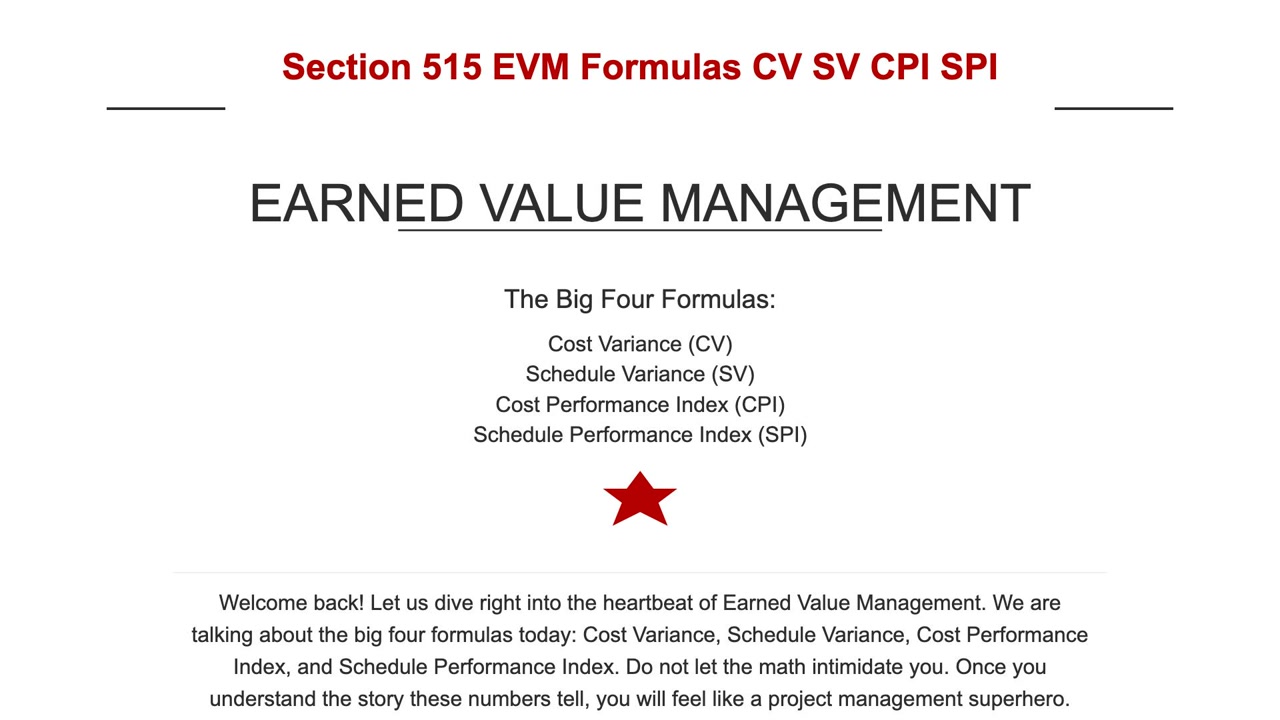
Earned Value Management (EVM) is a project performance measurement methodology that integrates project scope, cost, and schedule baselines. Key metrics include Cost Variance (CV = EV - AC), Schedule Variance (SV = EV - PV), Cost Performance Index (CPI = EV / AC), and Schedule Performance Index (SPI = EV / PV). Indices greater than 1.0 indicate favorable performance.
Why EVM Formulas & Forecasting Matter for PMP Math & Budget Control #
EVM questions appear on every PMP exam. Understanding the indices eliminates memorization stress and allows rapid calculation of projected project completion costs (EAC).
Standard Syntax, Derivation & Framework Pattern #
/* EVM Formula Cheat Sheet */
PV   = Planned Value (Budgeted Cost of Work Scheduled)
EV   = Earned Value  (Budgeted Cost of Work Performed)
AC   = Actual Cost   (Actual Cost of Work Performed)
BAC  = Budget at Completion (Total planned project budget)

Variances (Difference > 0 is GOOD):
  CV = EV - AC   [+ = Under budget, - = Over budget]
  SV = EV - PV   [+ = Ahead of schedule, - = Behind schedule]

Performance Indices (Ratio > 1.0 is GOOD):
  CPI = EV / AC  [> 1.0 = Cost efficient ($ earned per $ spent)]
  SPI = EV / PV  [> 1.0 = Progressing faster than planned]

Forecasts:
  EAC = BAC / CPI (If current cost performance is expected to continue)
  VAC = BAC - EAC (Variance at Completion)
  TCPI = (BAC - EV) / (BAC - AC) (To-Complete Performance Index)
Core Rules #
- Earned Value (EV) always comes first in variance and index formulas: EV - AC and EV / AC.
- CPI > 1.0 means you are earning more value than spending (under budget). CPI < 1.0 means cost overrun.
- SPI > 1.0 means you are completing work faster than planned. SPI < 1.0 means schedule delay.
- When CPI = 0.80, for every $1.00 spent, the project earns only $0.80 in planned value.
Visual 3-Step EVM Decoder: why Earned Value (EV) always comes first in every formula.
Frequently Asked Questions (FAQ) #
What are the core EVM formulas tested on the PMP exam?
The core EVM formulas are: Cost Variance (CV = EV - AC), Schedule Variance (SV = EV - PV), Cost Performance Index (CPI = EV / AC), Schedule Performance Index (SPI = EV / PV), Estimate at Completion (EAC = BAC / CPI), and To-Complete Performance Index (TCPI = (BAC - EV) / (BAC - AC)). Remember that Earned Value (EV) always appears first in variance and index calculations.
If a project has CPI = 1.2 and SPI = 0.85, what is the status?
The project is under budget (CPI > 1.0, earning $1.20 value per dollar spent) but behind schedule (SPI < 1.0, delivering only 85% of planned work).
What does a negative Cost Variance (CV) indicate?
A negative CV indicates that the project has incurred a cost overrun (spending more actual money than the earned value delivered).
How can I practice situational EVM questions before the PMP exam?
You can practice realistic scenario-based EVM calculations, S-curve graph interpretations, and index trend questions in our Pearson VUE PMP Exam Simulator at made2sticklearning.com/pmp-simulator.
Want complete video breakdowns, code files & exercises?
Explore comprehensive step-by-step masterclass training in our authoritative PMP Exam Prep Course & Exam Simulator or test your exam pacing on the Pearson VUE PMP Exam Simulator.